Shelf-Serving to Self-Serving: Who Is Responsible When Food Systems Fail?
Nutrition North Case Study
When designing food systems, we tend to focus on outcomes: reduced costs, tonnes of food delivered, or shifts in food insecurity rates. These metrics are important, but they can obscure a more fundamental question—why those problems exist in the first place.
Food is not simply an economic good; it is tied to geography, culture, and survival. Yet over time, its provision has been increasingly outsourced to complex networks of government programs and private intermediaries. In doing so, we have moved from food sovereignty toward dependency on systems that are not always transparent or fully understood.
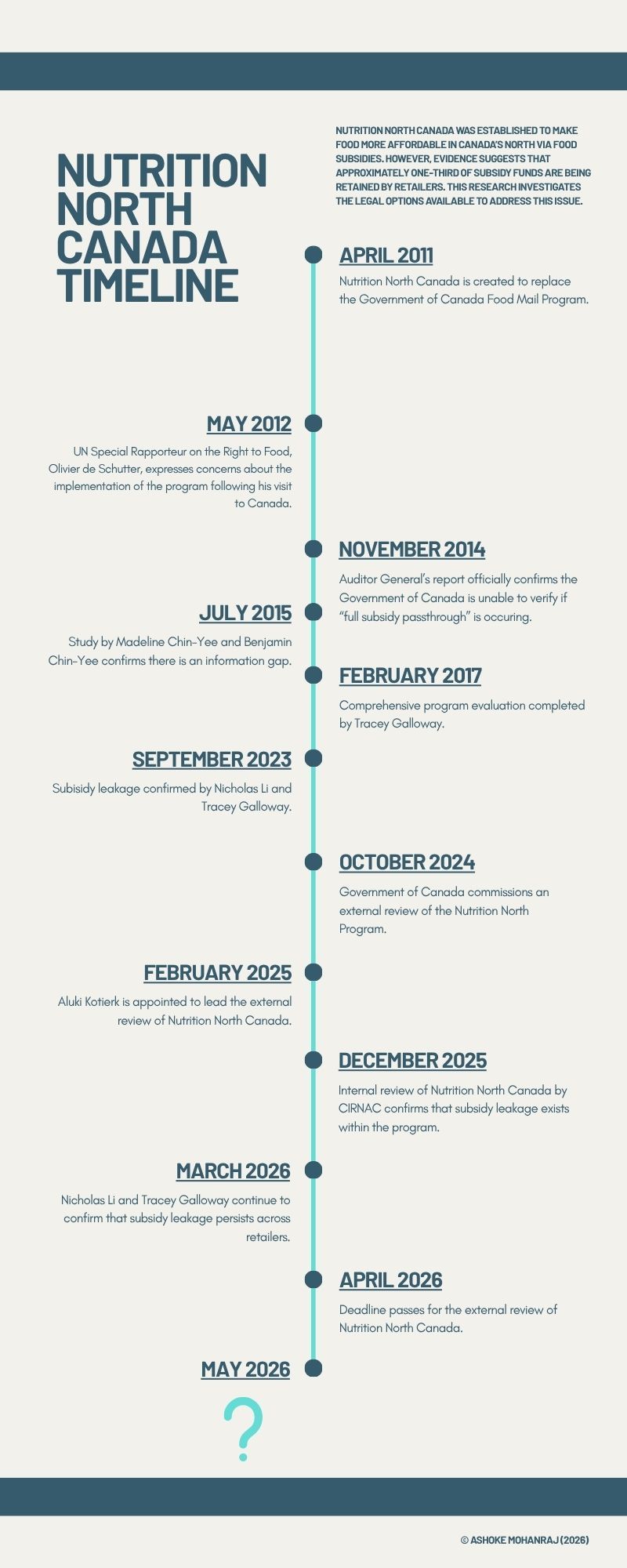
In Northern Canada, where food insecurity remains among the highest in the country, the federal government introduced Nutrition North Canada (NNC) in 2011. The program subsidizes food transportation costs in remote communities, relying on private retailers to pass those savings on to consumers.
However, more than a decade later, concerns persist about whether those subsidies reach their intended destination. A 2023 study found that, on average, only about 67 cents per dollar makes it to the consumer.
This raises an uncomfortable question: where is the remaining 33 cents going and who is responsible when intended public benefits are diluted, not simply through mismanagement by independent actors, but through the very structure and design of the program itself?
Is it retailers, if they are capturing part of the subsidy within dubious pricing schemes? Or is it the government, for designing a system that makes this kind of “leakage” not just possible, but foreseeable?

How Nutrition North Canada Works and Where It Fractures
Nutrition North Canada does not subsidize consumers directly. Instead, it operates through “contribution agreements” with retailers, under which funding is provided on the condition that subsidies are fully passed on to consumers.
In theory, this creates a simple mechanism: public funds reduce transportation costs, retailers pass on savings, and consumers benefit through lower prices. In practice, this model depends on assumptions that often do not hold in remote northern markets—particularly competition, transparency, and enforceability. Many communities are served by only a small number of retailers, and in some cases a single dominant supplier.
Where competition is limited, pricing discipline weakens. Retailers are not acting as neutral conduits of public benefit, but as economic actors responding to logistical constraints, market conditions, and margin pressures.
At the same time, oversight mechanisms are limited. Government reporting tracks subsidy distribution, but provides far less visibility into how those funds translate into final retail prices. This creates a persistent gap between input (public expenditure) and output (consumer impact), with limited capacity to verify whether the policy is working as intended.
The result is not necessarily misconduct, but a structural design problem: a system in which leakage is not an anomaly, but a predictable feature of the architecture itself.
Fragmented Responsibility and Legal Accountability
At first glance, responsibility appears to rest with retailers as the immediate actors within the system. However, because NNC is federally administered, it also sits squarely within public accountability.
This creates structural ambiguity. The government can point to funds disbursed and an arms-length framework. Retailers can point to operational realities such as transportation costs and limited market size. Meanwhile, communities continue to face persistently high food prices, with limited transparency into where the system is failing.
There is already private litigation underway against retailers, including a class action involving the North West Company. But this raises a broader question: does private liability resolve public responsibility?
Over the past two years, I’ve been exploring whether accountability can also be grounded in action against the Government of Canada through two possible avenues.
The first is judicial review, focused on the decision to continue awarding and maintaining contribution agreements with retailers who are allegedly non-compliant, rather than suspending or restructuring those relationships.
The second approach is a Charter-based challenge under Section 7. The core argument is that the design and ongoing state control of a food subsidy system operating in regions with significant Indigenous populations engages fiduciary obligations and the honour of the Crown in a way that warrants heightened scrutiny. If the state actively designs and regulates a system that directly shapes access to basic subsistence, then the persistence of deprivation, despite that intervention, may raise serious questions under the right to life and security of the person.
Once governments legislate or design public programs, they open themselves to Charter scrutiny. Courts have increasingly demonstrated a willingness to engage with systemic harm through Charter frameworks, as seen in Mathur v Ontario, particularly in the context of climate litigation. The question is whether that same reasoning could extend to food systems, where even when prices appear to decrease on paper, underlying food insecurity may still persist in practice.
However, this ultimately confronts a doctrinal threshold: whether Section 7 can impose positive obligations on the state. Recognizing such a claim would effectively move toward a justiciable right to food. Current jurisprudence has largely resisted that interpretation, though it is not entirely foreclosed. Notably, Gosselin v Quebec left open a narrow possibility for future development in exceptional circumstances.
So the question becomes: in a context of persistent food insecurity in Canada, increasing climate-related harm, and evidence suggesting that subsidy benefits may be diluted or captured due to program design, do these conditions amount to the kind of “special circumstances” contemplated in existing Charter jurisprudence?
Ultimately, that is the threshold question any potential claim against the Government of Canada would have to confront if it were to be tested in court.
Reimagining Food Systems: What Needs to Change
If current approaches are falling short, the question is not just what is broken—but what a more accountable food system would actually require in practice.
At a minimum, transparency has to be treated as non-negotiable. Without meaningful access to data on pricing, margins, and distribution, it becomes impossible to assess whether public subsidies are working as intended. Transparency is not a procedural add-on; it is the basic condition for any form of accountability to exist.
But transparency alone is not enough if there are no consequences attached to what it reveals. Monitoring without enforcement risks becoming a reporting exercise rather than a governance tool. Where public funds are consistently not translating into intended outcomes, governments must be willing to intervene, redesign programs, or, where necessary, end relationships that are structurally failing.
At the same time, food systems cannot be designed in abstraction from the people they are meant to serve. Communities experiencing food insecurity—particularly Indigenous communities—must be placed at the centre of decision-making, not treated as downstream recipients of policy. This includes strengthening Indigenous food sovereignty and supporting local, community-led systems that reflect lived realities rather than distant administrative assumptions.
More fundamentally, access to food has to be understood as more than a market outcome. Markets can play a role, but they cannot be the sole mechanism through which basic needs are met. When systems fail to deliver equitable access, the responsibility does not disappear—it shifts back onto the state to ensure that failure does not translate into deprivation.
Finally, and perhaps most importantly, we need to rethink the architecture of subsidy design itself. The core question is not only how much public money is being spent, but how that money moves through the system and whether the structure itself is fit for purpose. That means seriously evaluating whether indirect models relying on private intermediaries are the most effective way to deliver public benefit, or whether alternatives such as direct-to-consumer supports, community-controlled funding models, or hybrid approaches would better ensure that value actually reaches people.
Taken together, these shifts point to a broader reorientation. The issue is not only improving a program like Nutrition North Canada, but confronting the deeper question it reveals: when public systems are designed to address basic needs, accountability cannot end at implementation. It must extend to structure, design, and purpose itself.